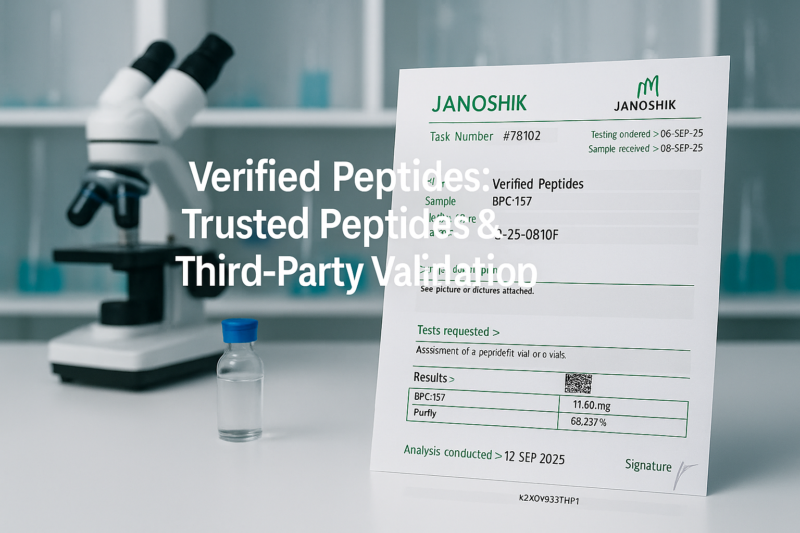
Peptide Top Quality: Importance Of Third-party Recognition
Peptide Quality Control & Purity Screening Boc Scientific Researches
In vivo tests evaluate absorption, circulation, metabolic rate, and discharging (ADME) attributes, even more confirming effectiveness and safety. These testing services not only assist clients maximize items specifically during growth yet additionally offer solid information support for governing conformity of peptide formulations. Beware of COAs that provide a purity number without any sustaining chromatographic information, record purity without specifying the analytical technique, or listing a molecular weight without mass spectrometry confirmation. Tandem mass spectrometry (MS/MS or MS TWO) pieces the peptide ions in the gas stage and evaluations the fragment masses. This is the gold requirement for peptide identity-- it validates Click here! both the make-up and the sequence. For numerous peptide jobs, outright peptide amount matters as long as chromatographic pureness.- When you see peptides marketed as "research-grade," it refers to their planned use and the degree of producing oversight.
- Documents evaluation asks whether the record is batch-specific, deducible, and detailed enough to be examined.
- In the typical peptide COA context, optimal pureness generally refers to the percentage of overall chromatogram location stood for by the primary peptide peak.
- Residual-solvent or water-content tests can matter in manufacturing or security contexts.
Apex Research Laboratory Content Team
The buddy web page on why 99 percent purity issues explains why little contamination percentages can still matter in sensitive in-vitro assays. Along with this peptide testing overview, those web pages create the trust-methodology layer behind the item directory. Peptide screening is effective, yet scientists ought to read the extent of each method carefully.
They are classified "for research study usage just" to explain that they are intended for in vitro experiments or animal researches, not for any kind of type of human usage. As a matter of fact, a laboratory offering peptide testing have to supply data meeting the rigorous analytical expectations of companies like FDA and EMA [4] By using a qualified third-party lab, peptide suppliers or researchers make sure an objective and skillfully recorded assessment of high quality, which is specifically what inspectors look for. In addition, recurring independent testing supports compliance in set release and quality assurance. Research laboratory recognition for peptides means making use of scientific examinations to confirm a peptide's identity, pureness, and composition. In technique, this typically entails third-party or independent testing by an external lab to validate that a peptide item really contains what the tag claims [2]Why Does Apex Usage Both Hplc And Mass Spectrometry?
Reputable peptide screening labs will supply a suite of modern logical techniques-- HPLC paired with MS is a must, and accessibility of added approaches like capillary electrophoresis or amino acid analysis is a bonus. Be careful of laboratories that do not use mass spectrometry along with HPLC, as this could miss out on essential identification info. In a similar way, avoid labs that can not demonstrate validated logical techniques. In accordance with ICH guidelines, verified approaches suggest the laboratory has developed the test's accuracy, precision, discovery limitations, and so on, ensuring the information you get are trustworthy.Examinations can be carried out using high-precision stablizing chambers, simulating various settings, and using worldwide criteria to examine short-term and Look at more info long-term stability, essential for constant peptide efficiency. Some peptides fail not since the series is incorrect, yet because their physical actions in actual solvents is badly understood. We give physical building screening that assists teams work better with difficult samples. Mass spectrometry validates whether the gauged mass matches the expected peptide mass. The chromatogram is one of the most important aesthetic data element on an HPLC peptide examination record. It is a graph with time on the straight axis and detector reaction, usually UV absorbance, on the vertical axis.
This degree of thorough analysis makes certain the peptide's precision-- meaning the sequence and purity are exactly as identified-- which is vital for speculative reproducibility. By confirming composition with several confirmed approaches, laboratory recognition guarantees that researchers get a high-purity peptide that will certainly perform as anticipated in the lab. Laboratory validation of peptides is not just a clinical best technique-- it's commonly a governing demand when peptides are utilized in therapeutic development or clinical research.
HPLC tells you what percentage of your example is the main substance-- yet it does not confirm what that main substance actually is. A height with the best retention time might theoretically be an associated peptide with comparable hydrophobicity. Mass spectrometry supplies identity verification by gauging molecular mass directly. We assess peptide length, series structure, expected molecular weight, adjustment type, salt type, sample history, and designated downstream use before specifying the logical path. Theoretically, peptide pureness is evaluated by the chromatogram produced by reversed stage HPLC, and on top of that, we can acquire the number and relative quantity of possible by-products by determining the peak location. A high-quality chromatogram has a solitary, symmetrical main optimal with a flat baseline on either side. " Tailing"-- where the peak routes off gradually on one side-- can indicate column troubles, example overloading, or second interactions between the peptide and the stationary stage. In this setup, the fixed stage is hydrophobic (water-repelling), normally C18-bonded silica. The mobile stage is a slope of water and an organic solvent like acetonitrile, usually with a small amount of trifluoroacetic acid (TFA) to develop the tops.